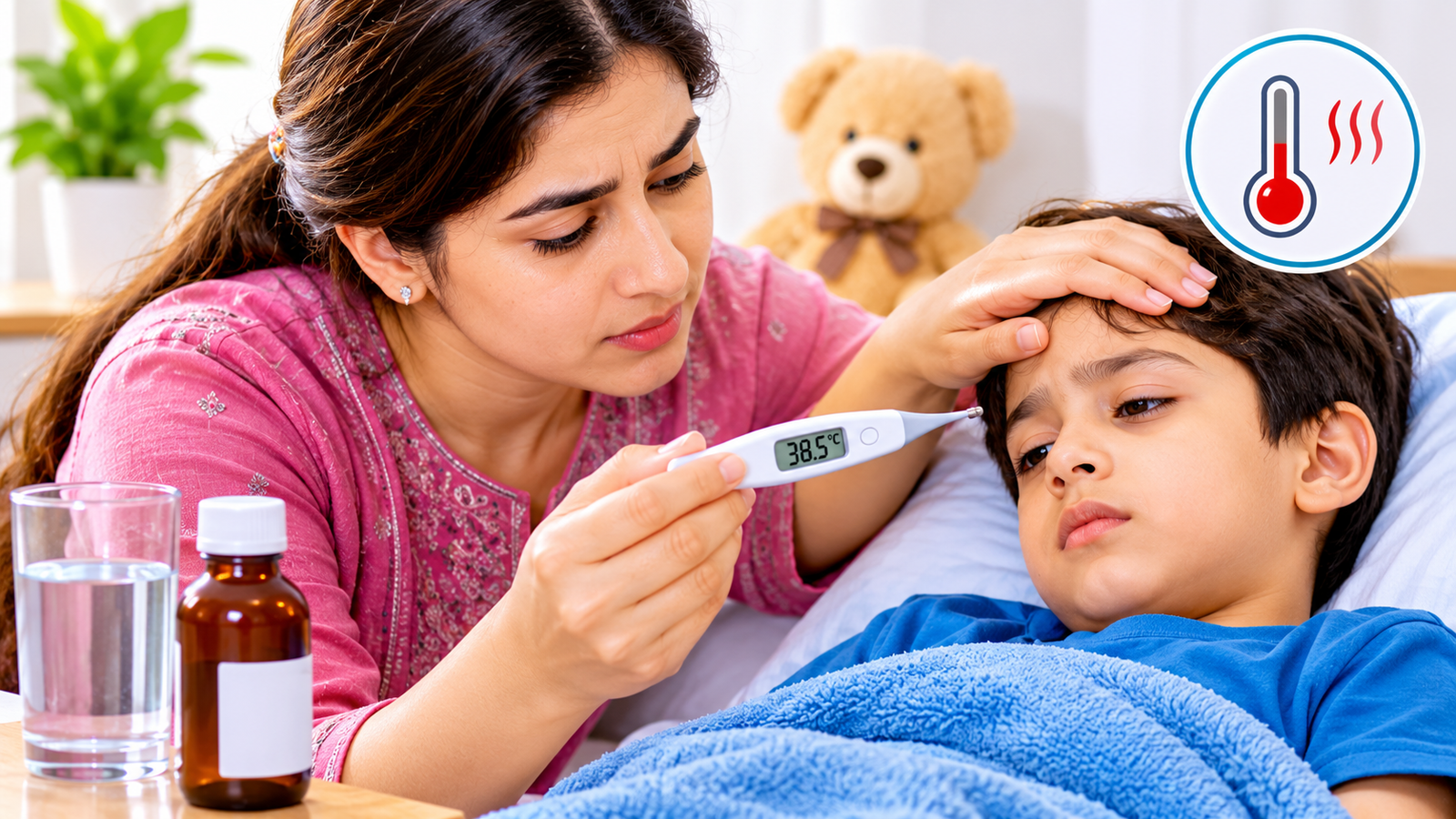
Fever in children is one of the most common reasons parents feel worried, especially at night. A hot forehead and a tired, cranky child can feel scary. The good news is that most fevers are mild and settle with simple care at home.
In this guide, you will learn how to check a temperature correctly, 10 safe ways to care for fever in children at home, what to avoid, and the warning signs that mean you should see a doctor quickly.
- Fever in children is usually the body’s normal reaction to an infection.
- A temperature of 38°C (100.4°F) or higher counts as a fever.
- How your child behaves matters more than the number on the thermometer.
- Babies under 3 months with a fever need to see a doctor urgently.
What Is a Fever and What Causes Fever in Children?
A fever is a high temperature. In children, a temperature of 38°C (100.4°F) or higher is usually counted as a fever. Normal body temperature is around 36 to 37°C.
A fever is not an illness by itself. It is a sign that the body is fighting something, most often an infection. The most common causes of fever in children are:
- Colds, flu and other viral infections
- Ear, throat or chest infections
- Stomach infections with vomiting or loose motions
- Urine infections
- Childhood illnesses such as chickenpox and measles
- Recent vaccines, which can cause a mild fever for a day or two
- Overheating from too many clothes or blankets
Most fever in children comes from viruses, so antibiotics usually do not help. If a cold is behind the fever, you can read our home remedies for cold and flu, but remember that some of those tips, such as honey and steam, are not safe for babies and young children.
How to Check a Temperature Correctly
A digital thermometer placed under the armpit is the easiest and safest way for babies and young children. Ear thermometers can be used for older babies and children, if you follow the instructions that come with them.
Touching the forehead with your hand is not reliable. Forehead strips are also not accurate. Do not use an old glass mercury thermometer, because it can break.
Take the temperature when your child is calm, and not straight after a bath, a hot drink or heavy clothing.
Remember that behaviour matters more than the number. A child who plays, smiles and drinks is usually less worrying than a child who is weak, floppy or very sleepy, even with a lower temperature.
10 Safe Ways to Care for Fever in Children at Home
These steps for fever in children focus on comfort. The goal is to keep your child comfortable and safe, not to push the temperature down to normal.
1. Offer Plenty of Fluids
Children lose more water when they have a fever. Give small, frequent sips of water, and breastfed or formula-fed babies should feed more often.
If your child has vomiting or loose motions as well, ask a doctor or pharmacist about oral rehydration solution (ORS).
2. Dress Your Child Lightly
Do not wrap your child in thick blankets or many layers. A thin cotton layer is enough. Too much clothing can raise the temperature even more.
3. Keep the Room Comfortably Cool
Keep the room at a comfortable temperature with some fresh air. Do not make it very cold, and do not point a fan or air conditioner straight at your child.
4. Let Your Child Rest
Rest helps the body fight infection. Do not force your child to play or study. Keep your child at home until the fever has gone, and ask your doctor when it is safe to return to school.
5. Give Light and Easy Food
Your child may not want to eat much, and that is fine for a short time. Offer light foods such as soup, khichdi, banana, yoghurt or plain rice, but do not force food. Fluids matter more than meals.
6. Use Children’s Medicine Only If Needed
If your child is uncomfortable, in pain or very upset, a children’s medicine can help. You do not need medicine just because the temperature is high if your child is otherwise comfortable. See the safety rules in the next section.
7. Watch Your Child’s Behaviour
Check whether your child is drinking, passing urine, playing a little and waking easily. These are good signs. If your child becomes more sleepy, weak or irritable, get medical advice.
8. Check the Temperature, But Do Not Overdo It
Check the temperature every few hours, or if your child seems hotter. You do not need to wake a sleeping child just to take it.
9. Do the Glass Test if There Is a Rash
Press the side of a clear glass firmly against the rash. If the spots do not fade under the glass, this is an emergency, so go to the nearest hospital at once. On darker skin, look at paler areas such as the palms and soles.
10. Keep Simple Notes
Write down the temperature, the time, any medicine you gave, how much your child drank and how often they passed urine. This helps the doctor understand what is happening if you need to visit.
Medicines for Fever in Children: Safety Rules
Children’s paracetamol or ibuprofen can make your child more comfortable. They do not cure the infection, and they may not bring the temperature fully back to normal. Follow these safety rules:
- Read the label and choose the product made for children, with the right strength for your child’s age and weight.
- Measure with the syringe or spoon that comes with the medicine, not a kitchen spoon.
- Never give more than the label says, and never give two products that contain the same medicine.
- Do not give aspirin to a child under 16.
- Do not give adult medicines to children.
- Ask a pharmacist or doctor if you are not sure, especially if your child has asthma, stomach problems or is dehydrated.
- Babies under 3 months with a fever should see a doctor before any medicine is given.
What to Avoid When Your Child Has a Fever
- Cold sponging or ice baths: they do not help and can make your child shiver and feel worse.
- Heavy blankets or thick clothes: they trap heat.
- Antibiotics without a prescription: most fevers are viral, and antibiotics do not treat viruses.
- Giving medicine only to chase a number: a comfortable, playful child may not need any.
- Waiting too long with a young baby: a fever in a baby under 3 months needs a doctor.
- Forcing food or drink: offer small amounts often instead.
When Fever in Children Needs a Doctor
Most fevers are harmless, but some need medical help. Use this table as a simple guide.
| Situation | What to do |
|---|---|
| Baby under 3 months with a temperature of 38°C or higher | See a doctor urgently, on the same day |
| Baby 3 to 6 months with a temperature of 39°C or higher | Get medical advice urgently |
| Fever lasting more than 5 days at any age | See a doctor |
| Fever that does not come down, or your child is getting worse | See a doctor soon |
| Signs of dehydration: dry mouth, no tears, fewer wet nappies, very little urine | See a doctor the same day |
| Fever with a fit (seizure) | Treat as an emergency |
- A rash that does not fade when you press a glass on it
- Trouble breathing, fast breathing or grunting sounds
- Skin that looks very pale, blue, grey or mottled, or feels very cold
- Is floppy, hard to wake, or does not respond to you
- A stiff neck, or bright light hurts the eyes
- A fit that lasts longer than 5 minutes
Febrile Seizures: What Parents Should Know
Some children between 6 months and 3 years can have a seizure (fit) when the temperature rises quickly. It looks frightening, but it is usually short and harmless. It happens in a small number of children when fever in children rises fast.
If your child has a seizure:
- Stay calm and note the time.
- Lay your child on one side on a soft, safe surface.
- Do not put anything in the mouth and do not hold the child down.
- Loosen tight clothing.
- Seek urgent medical help if it is the first seizure, lasts more than 5 minutes, or your child has trouble breathing or does not wake up afterwards.
How Long Does Fever in Children Last?
Most fever in children caused by a virus improves within 2 to 3 days. Your child should slowly feel better and start to eat and play again.
If the fever lasts more than 5 days, see a doctor, even if your child seems fairly well.
Fever After Vaccination
A mild fever is common for a day or two after vaccines. Keep your child comfortable, offer fluids and follow the advice from your clinic. See a doctor if the fever is high, lasts more than 2 days or you are worried.
How to Lower the Risk of Fever in Children
You cannot stop every fever, but a few habits lower the risk of infections:
- Wash your child’s hands often with soap, and before meals.
- Keep vaccinations up to date.
- Give clean, safe drinking water and fresh, well-cooked food.
- Keep children away from people who are sick when possible.
- Breastfeed babies if you can, because it helps protect them from infections.
- Make sure your child gets enough sleep and a balanced diet.
Frequently Asked Questions
What is the best way to treat fever in children at home?
The best way to manage fever in children at home is to give plenty of fluids, dress your child lightly, let them rest and watch their behaviour. Use children’s medicine only if your child is uncomfortable, and follow the label.
What temperature is a fever in a child?
A temperature of 38°C (100.4°F) or higher is usually counted as a fever. Always look at how your child behaves too, not only the number.
Is fever in children dangerous?
Most fevers are not dangerous, and they are a sign that the body is fighting infection. They need attention in young babies, when the fever lasts a long time, or when your child has warning signs.
Should I give medicine for every fever?
No. If your child is playing and drinking, you can often just watch. Use children’s medicine if your child is in pain or very upset, and always follow the label or your doctor’s advice.
Can teething cause a high fever?
Teething can make a baby fussy and slightly warm, but it does not usually cause a high fever. Do not blame a high temperature on teething, and see a doctor if you are worried.
When can my child go back to school?
Most children can return when the fever is gone and they feel well enough to eat, drink and play. Ask your doctor or school for their advice, especially after an infection.
Final Thoughts
Fever in children is common, and most of the time it passes with rest, fluids and loving care. Watch your child’s behaviour, keep them comfortable, follow medicine labels carefully, and do not wait if you see any warning signs.
If you are ever unsure, speak to a doctor or go to the nearest hospital. For more trusted guides on child care, browse our Children’s Health section.